Murals in the Chicago Loop Post OfficeMurals in the Chicago Loop Post Office
Thomas and Mary Tracy Foy How Eddie Foy Got His name About PetersPioneers Contacts Home Page
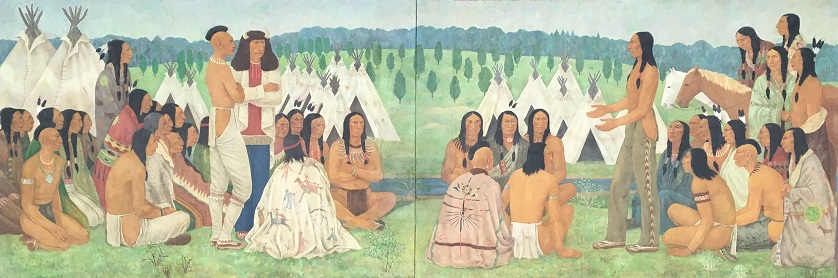
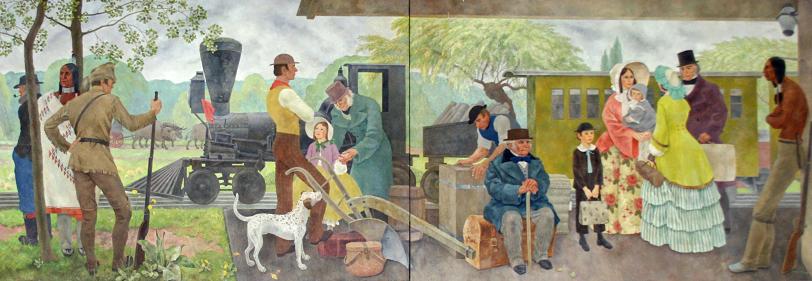
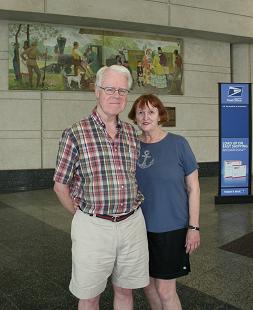
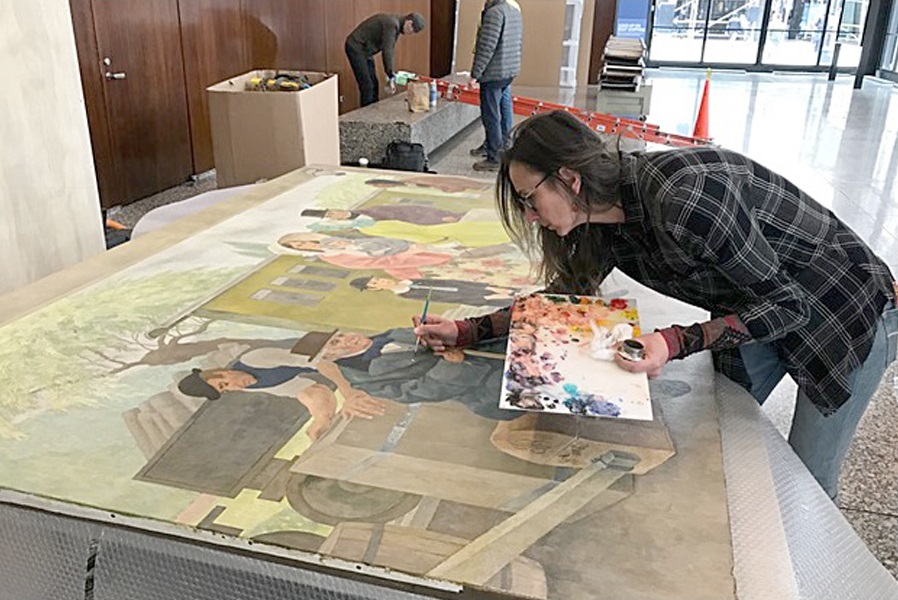
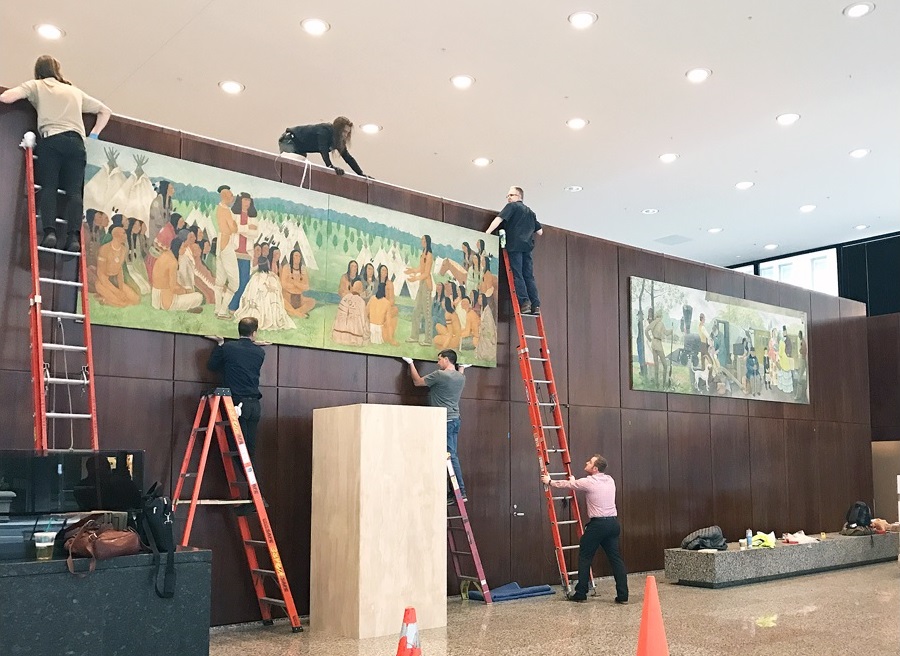
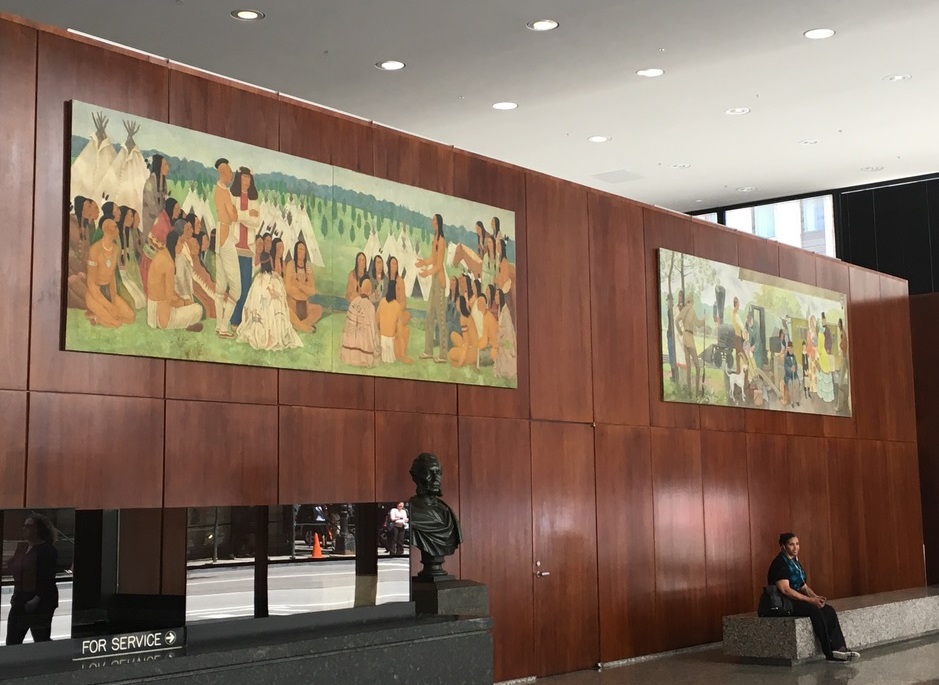
In 2008, my wife Marilyn and I paid another visit to Chicago Main Post Office on West Harrison Street. This time Marilyn suggested we visit the Postmaster. We phoned up from the lobby and were thrilled when Musette Henley, customer relations coordinator, came down to meet us and took us up to meet the postmaster, Gloria E. Tyson, who was very gracious and discussed efforts to preserve murals in post offices around the country. Musette gave us pins with stamps on them and introduced us to Mikal J. Sutherlin, communications specialist, who took us back down to the East Lobby and took the excellent photographs seen on this page. The Chicago Main Post Office was completed in 1997, replacing the old one across the street at 404 W. Harrison Street. The old one had been built in 1921 and expanded in 1932. Congress Parkway runs underneath the old one. The Frances Foy mural was commissioned by the United States Department of Treasury, Section of Fine Arts, for the Chestnut Street Post Office, a new Art Deco building at 830 N. Clark Street, where it hung for almost fifty years opposite a mural entitled "Great Indian Council, Chicago—1833" by Gustaf Dalstrom, husband of Frances Foy. Both murals were done in 1938 and are 15' x 5' oil on canvas. The Chestnut Street Post Office was converted to a movie theater (Chestnut Station Theaters) in 1983, separating the two murals. The Gus Dalstrom mural was moved to the one-story Loop Station Post Office designed by Ludwig Mies van der Rohe in the Federal Center at 219 S. Clark Street. The Frances Foy mural disappeared from view for 14 years until it was hung at the new Chicago Main Post office in 1997. Perhaps some day the two murals will be reunited. In August 2017, I received an email from Nick Fujii saying "Just to let you know both paintings have been reunited and are in display in the Loop post office. It also looks like the Great Indian Council painting has had some restoration work done to it. Hope this helps your page." In a subsequent email, he said "I work next door at the federal building. I'll stop over at the post office and take a picture of them together after work today. I can tell the Great Indian council has had some work because it was missing pain in spots that now have paint." A little on-line searching told me that in April 2017, the two murals had been brought together in the Loop Post Office and refurbished by the General Services Administration. Link, a publicatioon of the Postal Service included an item entitled "Fresh start: Post Office murals restored, reunited." Elizabeth Kendall of Parma Conservation told me it was they who suggested reuniting the two murals. They restored the Dalstrom mural. "It was an amazing project." She said Parma's team did not restore the Foy mural, that was done many years ago. They moved the Foy mural "so that it would be near its companion mural. We removed very superficial dust from the Foy mural at that time, but there was no change to the mural."
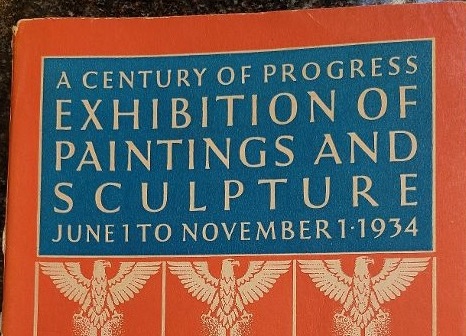
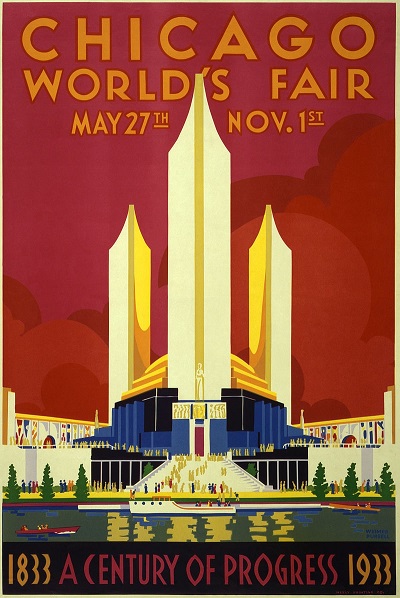
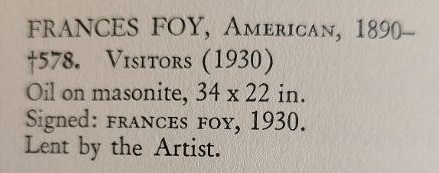
Chicago Society of Artists. Frances and her husband Gus Dalstrom were members of the Chicago Society of Artists. The Chicago Society of Artists, which dates back to 1887, has its primary objective, the advancement of art in Chicago and the cultivation of a climate to support the production and display of member art works. Historical information can be found in Role and Impact: The Chicago Society of Artists, published in 1979 by the Society and written by its 27th President, Louise Dunn Yochim. On page 102, Louise mentions Frances and her husband Gus Dalstrom among 33 deceased members of the Society who had been in the Society for more than 30 years. Frances was never President of the Society, but her husband Gus Dalstrom was the 18th President of the Society. In autumn 1928, Frances and her husband Gus Dalstrom were among 54 artists from the Society invited to present their work at an "Autumn Exhibition" in the Stevens Hotel on South Michigan Avenue at Seventh Street. Gus Dalstrom was one of seven members chosen by the members of the Society to serve on the Jury of Selection for the show. In 1936, published it first annual blockprint calendar, for 1937. The purpose was to publicize the Society and raise income for the Society. Frances and her husband Gus Dalstrom contributed to this first issue of the calendar. Gus was a moving force behind the calendar venture for many years. Romany Club Exhibition. In October 1927, Frances and her husband Gus Dalstrom were among 40 artists from the Chicago Society of Artists invited to participate in a show staged by the Illinois Academy of Fine Arts at the Romany Club, 36 Belleview Place, in Chicago. Art of Today: Chicago, 1933. In 1932, L. M. Stein published a book in Chicago entitled Art of Today Chicago 1933, by J. Z. Jacobson. According to the Illinois Historical Art Project, the book "was groundbreaking for its treatment of modern art and coverage of those artists in Chicago who were then coming into favor with a conservative public." Included in the book was the following commentary by Frances Foy. When an artist is confronted with questions as to why or how he paints he generally says he paints because he must and as he feels. On consideration he finds much, much more to say, tho' it be but an elaboration of his first brief statement. In painting I consider subject matter as all-important. It is the magic key which unbolts the imagination. It also gives direction and character to the way a picture is painted. Consider, let us say, a bowl of fruit, and then a homeless old man asleep in a doorway. The rich color and voluptuous forms of the one contrast sharply with the somber color and rigid outlines of the other. Each calls for a different way of intensifying and clarifying to make the picture true. Again, the artist may view these same subjects more personally, feeling with horror the fleetingness of the fruit's beauty, and regarding with warm sympathy the old man enjoying care-free sleep even in a strange doorway-this and endless variations, each calling for its particular artistic expression. So in painting I use whatever I have of knowledge and skill and feeling to portray the subject the way I see it. As long as any artistic quality—color, rhythm, abstract form—furthers this portrayal, I consider it good. If not, it is unnecessary. In fact any such art convention used for its own sake seems a kind of art self-consciousness, obtruding between the picture and the beholder. This is not saying that certain peculiarities of an artist's work, like certain endearing mannerisms of our friends, detract from our enjoyment of either. Rather they add to it. But their charm is lost when they appear to be used consciously. I live in Chicago and paint what I see about me. Only to this extent is my work of Chicago or of these times. Whitney Museum of American Art. In 1933, Frances and her husband Gus Dalstrom were among contemporary artists featured in a show, "Paintings & Prints By Chicago Artists" at the Whitney Museum of American Art in New York. The museum was founded in 1931 by Gertrude Vanderbilt Whitney after her collection of art was turned down by the Metropolitan Museum of Art. Art Institute of Chicago. From June 1 to November 1, 1933 and 1934, Frances and her husband Gus Dalstrom were among 39 members of the Chicago Society of Artists represented in "A Century of Progress Exhibition of Paintings and Sculpture." The art exhibition was organized by the Art Institute of Chicago in conjunction with the Fair, and consisted, with the exception of Whistler’s Mother, entirely of works in American museums and private collections. The art exhibition drew almost two million visitors.
In 1934, Frances was among artists featured in an "International Watercolor Exhibition." In 1934, Frances was among artists featured in an "International Exhibition of Contemporary Prints." In 1935, Frances and her husband Gus Dalstrom were among artists featured in an "International Watercolor Exhibition." The Art Institute sponsored annual Artists of Chicago and Vicinity Exhibitions. Prizes were awarded for oils, watercolors, prints, and sculptures. Frances won awards in 1931 and 1943. New Deal/WPA Art Project. On May 6, 1935, the Works Progress Administration (WPA) was created to help provide economic relief to the citizens of the United States who were suffering through the Great Depression. The Federal Art Project (FAP) was one of the divisions of the WPA created under Federal Project One. President Franklin D. Roosevelt had made several attempts prior to the FAP to provide employment for artists on relief. The first was the Public Works of Art Project (PWAP) which operated from December 1933 to June 1934. Frances Foy was a member of the Region 10 committee , which allocated funds for Illinois, Wisconsin, and Minnesota. The Treasury Department Section of Painting and Sculpture which was created in 1934 after the demise of the PWAP. However, it was the FAP which provided the widest reach, creating over 5,000 jobs for artists and producing over 225,000 works of art for the American people. For more on the New Deal/WPA art project, including a number of works by Frances Foy and her husband Gus Dalstrom, see New Deal/WPA Art Project. Delphic Studios. In May 1935, Frances was among 55 Chicago artists featured in an exhibition at Delphic Studios, a formal gallery established by Alma Reed on the top floor of the 12-story building at 724 Fifth Avenue between 56th and 57th streets, which now houses Prada. The exhibition was subsequently taken on a tour by the American Federation of Arts. In 1936, it was installed at the New Jersey State Museum in Trenton. From there, it traveled to Washington, D.C.; Delaware; Ohio; Bemidji, Minnesota; and Rockford, Illinois. Navy Pier Exhibition. In 1936, Frances and her husband Gus Dalstrom were among Chicago artists included in a show in the Exhibition Hall at Navy Pier sponsored by the Chicago New Century Committee established by Mayor Edward J. Kelly. Riverside Museum. In 1939, Frances was among 57 Chicago artists featured in an exhibition at the Riverside Museum, which was on the first three floors of a 27-story art deco building built in 1929 at 310 Riverside Drive at 103rd Street in New York. In 1945, the Chicago Society of Artists held an exhibition of prints at the Riverside Museum. An article in the New York Times for January 14 singled our etchings by Frances and her husband Gus Dalstrom. Smithsonian Institution. The Smithsonian Institution in Washington contains works by Frances Foy, including Frances Foy-Mother's Day, and her husband Gus Dalstrom. In 1987, the Frances Foy and Gustaf Dalstrom papers, 1909-1961 were donated to the Smithsonian Research Collections by their son Lars Dalstrom. Field Museum. Frances Foy's husband, Gus Dalstrom was an artist in the Department of Anthropology at the Field Museum in Chicago. Gus did the drawings for Digging into History, a book on archeology in New Mexico published by the museum in 1959. Newspaper Articles. There were three lengthy articles on Frances Foy in the Chicago newspapers.
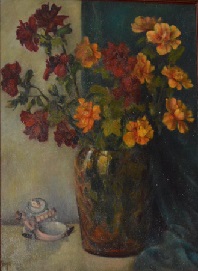
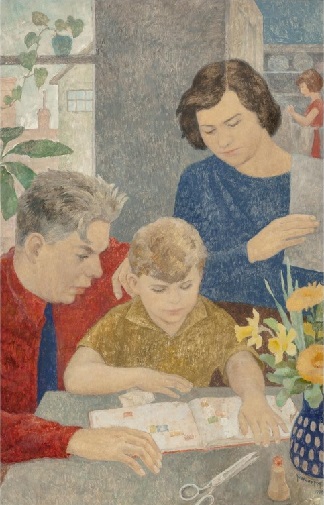
Associated with Chicago’s community of progressive artists early in her career, Frances Foy was a commercially successful illustrator, painter, and printmaker whose works include portraits, still lifes, and scenes of everyday life. Foy was born in Chicago and raised in suburban Oak Park. At school, she demonstrated a talent for drawing, and she spent a summer at the Chicago Academy of Fine Arts studying with portraitist Wellington Reynolds. Foy began working as a fashion illustrator before enrolling in evening classes at the Art Institute of Chicago’s school, where she again worked under Reynolds. She was influenced by visiting instructors George Bellows and Randall Davey, who inspired a generation of young “rebels” among Chicago’s artists. Among them was painter Gustaf Dalstrom, whom Foy married in 1923. Foy began exhibiting her paintings as early as 1922, when her work first appeared in the No-Jury Society of Artists exhibitions, an alternative to the Art Institute’s annual shows. By 1926, the Art Institute was displaying her canvases as well. Foy and Dalstrom exhibited with the so-called Fifty-seventh Street art colony, and both were elected directors of the No-Jury Society. Foy’s work was featured in solo exhibitions sponsored by Chicago Woman’s Aid in 1927 and at the Romany Club the next year. Also in 1928, she and her husband traveled throughout Europe. Foy received a gold medal from the Chicago Society of Artists in 1929, the year she was given a small solo exhibition at the Art Institute. She received several awards in the museum’s annual exhibitions during the early 1930s. J. Z. Jacobson included her in his 1932 book Art of Today: Chicago 1933, a compendium of Chicago’s modernist artists. In the 1930s Foy painted several post office murals under the auspices of the U.S. Treasury Department’s New Deal relief programs, and she served on the technical committee of the federal Public Works of Art Project. Floral still-lifes dominated Foy’s mature work as a painter in oils and watercolors. Alongside her husband in the studios of Hull House, Foy also learned to make etchings. In the 1930s the couple collaboratively illustrated an anatomy book. Their paintings of the Lincoln Park neighborhood, where they lived for many years, were featured in a joint exhibition at the Chicago Historical Society in 1948. Foy’s papers are preserved along with Dalstrom’s in the collection of the Archives of American Art.
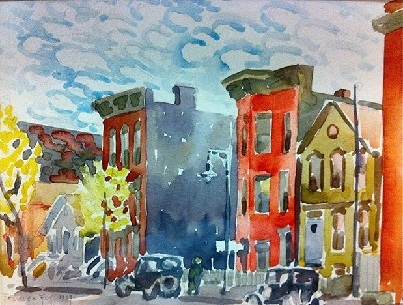
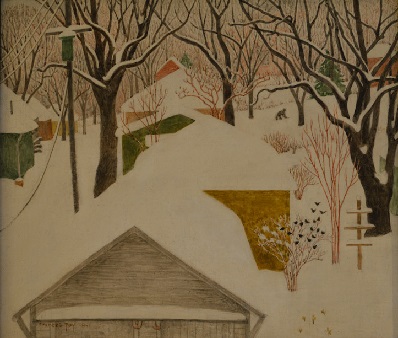
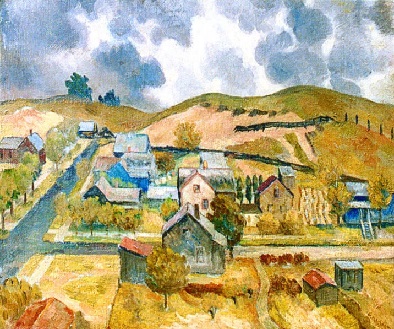
Frances Foy was born in Chicago but raised in the suburb of Oak Park, where she pursued her first artistic activities, winning a national prize for a drawing when she was just thirteen. Her first formal training was with the conservative artist Wellington J. Reynolds, in a summer program at the Chicago Academy of Fine Arts while she was still in high school. After graduation, she became a successful fashion illustrator, earning enough money to support herself, although she didn’t consider this occupation that of a real artist. She continued her fine art education in evening classes at the School of the Art Institute of Chicago (SAIC), studying with Reynolds, who now taught there, as well as with the New York urban realists George Bellows and Randall Davey, who were visiting instructors in 1919–20. Like many young artists, exposure to these teachers was liberating and affected Foy profoundly; along with classmates Frances Strain and Fred Biesel, Emil Armin, George Josimovich, and Gustaf Dalstrom, whom she married in 1923, she participated in the progressive movement that flourished in Chicago during the 1920s and 1930s. Although she continued to do commercial work, she began to exhibit her work in a variety of venues in the early 1920s. She showed regularly with the independent Chicago No-Jury Society of Artists, where she also took on a leadership role, as well as in the juried annuals at the Art Institute. She was a member of The Ten, another independent exhibition group of ten artists, many of whom lived in Hyde Park. In the late 1920s she was given solo shows at Chicago Woman’s Aid, the Romany Club, and the Art Institute of Chicago (she had another solo show at the AIC in 1940) as well as receiving a gold medal from the Chicago Society of Artists. She also garnered a number of awards in annual exhibitions at the Art Institute in the early 1930s. In 1928, she and Dalstrom, along with their artist-friends Frances Strain and Fred Biesel, and Hazel and Vin Hannell took a working trip to Europe, where Foy was exposed to the European modernists firsthand. Despite this, she maintained a strong connection to the representational world, and considered subject matter of utmost importance in her work, stating: “I use whatever I have of knowledge and skill and feeling to portray the subject the way I see it. As long as any artistic quality—color, rhythm, abstract form—furthers this portrayal, I consider it good.” The couple settled in the Lincoln Park area of Chicago, just north of Old Town, where they often painted scenes of community life including the park and its zoo and the neighborhood children in the schoolyard, which was visible from their second-floor, home studio. The delicate and brightly colored streetscape in the Untitled (Street view) depicts this neighborhood of Victorian homes with an immediacy and mastery characteristic of Foy’s watercolors. Foy was better known for her portraits and still lifes, but was always interested in the ordinary things she saw around her, investing them with richness and life. Foy and Dalstrom learned etching at Hull House where they had the use of a press, and were both members of the Chicago Society of Etchers. Foy’s Remembered Corner, an image of a Victorian table topped with a vase of flowers and a family picture in an ornate frame, is rendered with her characteristic delicacy and technical proficiency. The profusion of patterns, from the carpet and wallpaper to the lace edging on the fabric covering the table, the curtains, the elaborate wood work on the table, and the decorative chair that can be seen through the window combine to give a feeling of warmth, complexity, and animation in this unoccupied room. Despite the fact that Foy had a successful lifelong career, this image, like much of her work, exalts the domestic sphere and its “feminine” qualities.
| |||||||||||||||||||||||||||||||||||||||||||||||||
Five Foys from Derreennascooba About PetersPioneers Contacts Home Page