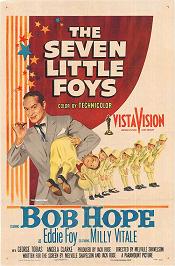
1955 Poster of Bob Hope as Eddie Foy in "The Seven Little Foys" |
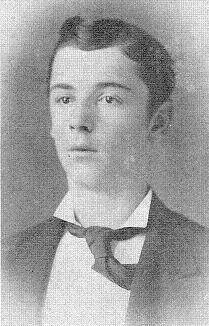
Edwin "Eddie" Foy at age 16 in 1872, when he changed his name from Edward Fitzgerald. Source: Eddie Foy: A Biography of the Early Popular Stage Commedian by Armond Fields, 1999. |
Are we related to Eddie Foy and the Seven Little Foys? No, but they may have gotten their name from us.
Eddie Foy was born Edward Fitzgerald in Greenwich Village, New York, in 1856. His parents Richard and Ellen Hennessy Fitzgerald had emigrated from County Limerick on the ship Maria Brennan, arriving at Castle Garden on June 8, 1850, with
three-year-old John and infant twins Johanna and Catherine. They had two other children besides Eddie in New York: Mary Ann in 1855 and Ellen in 1859. Their father Richard, who worked as a tailor, died in 1862.
The widow Ellen moved the family to Chicago in 1865 at the urging of her brother who lived there. Ellen cared for Mary Todd Lincoln, widow of President Abraham Lincoln, in Chicago from 1872 to 1875. Ellen died in Chicago in 1902.
Young Eddie eventually became famous as a comedic actor. He bought a house in Chicago for his mother in 1893. In 1896, Eddie married Madeline Morando, the mother of the Seven Little Foys. In 1900, Eddie and his family moved to 64 West 98th Street in New York City, In 1902, they moved to 151st Street and Eighth Avenue in Harlem. In 1903, they bought a house out in the country in New Rochelle that Eddie named the "The Foyer." Eddie died of a heart attack at the Hotel Baltimore in Kansas City, Missouri, in 1928. The funeral was at Blessed Sacrament Church in New York City on the upper West Side, and he was buried in Holy Sepulchre Cemetery in New Rochelle.
As a budding amateur genealogist in 2003, with Foy ancestors, I wondered whether we might be related to the famous Eddie Foy. It did not take long to find our that his name originally was Fitzgerald. So, I quickly forgot about that line of research.
Frances Foy Article. On a trip to Chicago in 2008, I paid a visit to the Visual and Performing Arts
Department at the new Chicago Public Library. After finding nothing on my great grandfather Cris J. Smith, who was a musical director in Chicago from the 1890s to 1920s, I asked if they had anything on Frances Foy (1890-1963), a Chicago artist and great granddaughter of my ancestor Thomas Foy who had a farm in the Partry Mountains in County Mayo, Ireland. Her grandfather, Thomas Foy (1830-1903), lived on O'Brien Street in Holy Family parish on the near west side of Chicago. The library found an article about Frances Foy in The Chicago Daily News of Saturday, August 24, 1935. The article was part of a series on "Artists of Chicago" by art critic C. J. Bulliett. The article was comprehensive and well written, but one thing popped out immediately: the comedic actor Eddie Foy knew Frances Foy's father, James A. Foy (1861-1943), and adopted his surname because he liked it and it would fit nicely on marquees.
Her father was - and is - James A. Foy. He went to parochial school in Chicago in his own youth. A playmate was Edward Fitzgerald. One day, when they had both become young men, they met again.
"Foy, I envy you. I wish I had a short name like yours," said Edward Fitzgerald, who was developing stage ambitions.
Years rolled by and "Eddie Foy" became a nationally renowned comedian. He was the Edward Fitzgerald of Chicago parochial school days.
When I got home to Connecticut, I called Lars Dalstrom, son of the artist Frances Foy. I told him about the article but he wasn't particularly impressed. "We always knew that Eddie Foy got his name from our family," he said.
Research. Encouraged by this conversation, I did a little more genealogical research. I found out that in 1877 an Edwin Foy, age 21, was boarding at 17 O'Brien Street in Chicago with Frances Foy's grandfather, Thomas Foy.
- 1860 U.S. Census: Edward Fitzgerald, 3, living with his parents, Richard and Ellen, and three sisters in New York.
- 1865 and 1866 Chicago city directories: Ellen Fitzgerald, widow of Richard, living in Holy Family parish on the near west side of Chicago, just north of Frances Foy's grandfather, Thomas Foy, who lived at 17 O'Brien Street (620 W. O'Brien Street after 1909) from 1865 to 1879.
- In 1865, the Fitzgeralds lived at 102 Bunker Street (617 W. Bunker Street after 1909). The name of Bunker Street was changed to Grenshaw in 1936.
- In 1866, the Fitzgeralds lived at 175 Taylor Street (621 W. Taylor Street after 1909).
- 1869 and 1871 Chicago city directories, Ellen Fitzgerald, widow of Richard, living in the Loop on West Madison Street.
- In 1869, the Fitzgeralds lived at 186 Madison Street (187 W. Madison Street after 1911).
- In 1870, the Fitzgeralds lived at 236 Madison Street (301 W. Madison Street after 1911).
- 1870 U.S. Census: Edward Fitzgerald, 13, living with his widowed mother Ellen, and sister Mary, 15, in the 1st Ward of Chicago (which includes 236 Madison Street).
- 1871 Chicago city directory: Ellen Fitzgerald, widow of Richard, living at 236 Madison Street (301 W. Madison Street after 1911). One male and two females living there.
- 1877 Chicago city directory: Edwin Foy, laborer, boarding at 17 O'Brien Street (620 W. O'Brien Street after 1909). This is in Holy Family Parish on the near west side of Chicago. From 1865 to 1879, it was the residence of Frances Foy's grandfather, Thomas Foy (1829-1903).
Autobiography. But the story does not end there. A few days later I got hold of an autobiography that Eddie Foy wrote with Alvin F. Harlow entitiled Clowning Through Life. It was published in 1928, but serialized earlier in Colliers from December 18, 1926, to February 19, 1927.
On page 4, Eddie Foy tells of his Irish Catholic roots.
My father, Richard Fitzgerald, ran a tailor shop. It occupied the front room of a two-story building, and we lived very comfortably in the other rooms above and back of the shop. Father and Mother had been married over in old Limerick a few years before and had crossed the ocean along with the hordes of Irish, English, and German immigrants who came to this country by the hundred thousand in those three or four decades just before the Civil War. Like Saint Patrick, we came of 'decent people.' My mother's brother was a missionary in some of the Pacific islands, and a very influential one, I'm told. I was brought up in strict piety, and though some folks may not believe it, the effects thereof never quite departed me.
In addition to his mother's brother who was a missionary, he mentions her brother who was a sailor and her brother in Chicago who sent them tickets to come there in April 1865 following the death of Richard in 1862.
On page 20, Eddie Foy talks about his education and an experience in 1868.
I almost never had any opportunity to go to school in my boyhood. Once I went a few months to a night school when I was about twelve; I didn't know then and I don't know now whether it was operated by the city or not.
* * *
My teacher at the night school was a beautiful and gracious lady who completely won my heart. It's hard for a boy to guess at adult ages; she might have been anywhere from twenty-five to thirty-five.
Eddie Foy does not mention where the family lived in Chicago except at the time of the Great Chicago Fire in October 1871. He devotes two chapters to a vivid description of escaping the raging fire with his infant nephew and reuniting with his family. Where they lived is key to his description. On page 28 he gives the location of their residence, and it is consistent with the city directory.
We were living on Madison Street then, opposite Franklin, and just east of the south branch of the river.
On page 58 of his autobiography, Eddie Foy says he took his name in 1872 from two sisters named Foy working in concert halls whom he admired very much.
I was sixteen when a very momentous event took place in my life. I changed ny name! Always trying to break into the show business at some crevice or other, I teamed up with one of my chums, a youth named Jack Finnegan, a year or two older than I was, to do acrobatic song-and-dance stuff.
* * *
Our two names, Finnegan and Fitzgerald, coupled together on a program didn't suit my partner. He said it sounded too Irish. I questioned whether anything could be too Irish, but he overruled me. He had decided to take the name of Edwards. I pondered long over my stage moniker. There were two girls, the Foy sisters, working in the concert halls then (they afterwards became very famous in vaudeville) whom I admired very much, and I could think of nothing better than their name. It was short and seemed to me to have a picturesque quirk about it that made it easy to remember. So our team became Edwards and Foy, and I have been Eddie Foy ever since.
No record has been found of two sisters named Foy working in concert halls.
In 1877, the year an Edwin Foy was listed in the Chicago city directory as a laborer boarding at 17 O'Brien Street in Chicago, Eddie Foy said on page 91 of his autobiography.
Now I was twenty-one, and hadn't yet gotten anywhere in my profession. . . . But, I was now right on the eve of a turn in my fortunes.
U.S. Census. In the 1900 census, Edwin Foy, actor, was living at 64 West 98th Street in Manhattan with his wife Madaline and Three Foys: Bryan, 3, Charles, 2, and Edward, 1/12.
In the 1920 census, Edwin Foy, widower, was living in a house he owned at 288 Weyman Avenue in New Rochelle with Seven Foys: Bryan, 23, Charles, 21, Richard, 19, Mary, 18, Madeline, 16, Eddy, 14, and Irving, 10. The occupation listed for all was actor-stage.
Biography. In 1999, Armond Fields, an historian specializing in American popular theater, wrote Eddie Foy: A Biography of the Early Popular Stage Commedian. This is an excellent book but does not shed any new light on how Eddie Foy got his name. On page 232, Fields comments on the autobiography.
Eddie wove an entertaining story, most of which was true, though sketchy, with the usual amount of revisionist history that an autobiography concedes.
Fields makes a comment on Eddie's education on page 102.
He had little formal education, having attended elementary school for no more than a few years.
Conclusion. We have two different stories on how Eddie Foy got his name.
- He knew one of our Foy relatives and liked the name.
- There were two entertaining Foy sisters whom he liked.
Maybe both stories are true.
Following is the article about Frances Foy transcribed from The Chicago Daily News of Saturday, August 24, 1935. (The paragraph about Eddie Foy is is bold.) The article was part of a series on "Artists of Chicago" by art critic C. J. Bulliett. See also The Art Project and the copy of the original article provided by the Visual and Performing Arts Department at the the Chicago Public Library.
FRANCES FOY
Article No. 27 August 24, 1935
 |
"I expected to see a Botticelli lady with a lily in your hand!" exclaimed an impulsive member of the Chicago Woman's Aid, startled on being suddenly introduced to Frances Foy. Instead, she was confronted by a smiling, blue-eyed, full-lipped Irish girl, looking and feeling her robust nationality. It was the youthful Miss Foy's paintings that had been at fault. They were delicate and spiritual and poetical - girls and girl children - maybe akin to "the Blessed Damozel" of Rossetti, but the Irish branch of the family, not the Italian.
While her work then, as now, may be of the racial inspiration that produced Irish poetry from Tom Moore to Yeats, Miss Foy has none of the morbid mysticism of the Yeats school of verse or the Dublin school of drama. She was fed plentifully in her childhood on giants and banshees of Irish folklore, her grandparents on both sides of the family vying with each other in telling her tall tales. But her mature outlook on life and her materials of art are the healthy, romantic, clear-eyed sentimentalism of Tom Moore, rather than the strange morbidities of the poets and dramatists of the new republic.
* * *
Not that she is Irish of the "auld sod" - she was born and brought up in America, and on her one visit to Ireland during the days of the rebellion, she found Dublin as strange as any of us might - strange as her mother found it, only in a different way.
The mother had been brought up there in a convent school which had been founded personally by Queen Victoria for the education of daughters of the veterans of the Crimean War. Mrs. Foy, who had married and emigrated to America, dreamed of a return to her convent for a living over, for a few hours, of the old times.
But years and the Irish uprisings had intervened. The French nuns were gone. Queen Victoria was not only dead but her spirit no longer brooded over rebellious Ireland.
* * *
Frances Foy financed this pilgrimage to Dublin for herself and mother out of her own earnings as an artist. Only now she doesn' t consider it "art" - it was "fashion drawing." She has been fortunate in developing a dual personality that is a rarity among artists. "Commercial work" takes heavy toll. The "commercial artist" at some time or other, and always after he makes a fortune, longs to turn "ethical" - to produce "real pictures." Usually his transformation is woefully incomplete. The resulting pictures bear a reminiscent stigma.
Frances Foy, however, has had no such difficulty. Her "fashion drawing" has been one thing - her "art" another, no more related, apparently, than is this "art" to an old job of hers as filing clerk at Donnelley's printing establishment.
She went in for "fashion drawing" in the flush times immediately after the World War and got out of it not only her trip to Europe, but trips to New Mexico, New York, and wherever else her fancy led her.
* * *
Miss Foy was born in Chicago on Congress Street near where that thoroughfare cuts Sacramento Boulevard. The house still stands. Her first remembered experience of "art" was a carpet on the bedroom floor with pomegranates in the pattern.
Her father was - and is - James A. Foy. He went to parochial school in Chicago in his own youth. A playmate was Edward Fitzgerald. One day when they had both become young men, they met again. "Foy, I envy you - I wish I had a short name like yours," said Edward Fitzgerald, who was developing stage ambitions. Years rolled by and "Eddie Foy" became a nationally renowned comedian. He was the Edward Fitzgerald of Chicago parochial school days.
Before she was old enough to protest, the Foy's left Congress Street and took Frances to live with them in Oak Park. There, at the age of 13, she won a school prize in drawing. But it was a lot bigger than just that - the prize was awarded in New York, where work from Oak Park had been submitted in competition with work from the country over.
* * *
The Foys naturally were elated, and the following summer they sent Frances to the Chicago Academy of Fine Arts to study with Wellington J. Reynolds. That was the beginning of her "formal" art education, as well as the extent of it for some years to come. Out of that summer's training and the training she got the next few years in high school, she developer her facility for fashion drawing and easy money.
While in high school, incidentally, she illustrated for the high school paper stories by Susan Wilbur, now Mrs. Llewellyn Jones and a literary critic and author in her own right.
Presently, after high school, Miss Foy went to Donnelley's as file clerk. But she had art ambitions. Donnelley's published books among their numerous printing enterprises, and Frances Foy hoped the contact would result in her becoming a book illustrator. It didn't, and she quit.
But the old ambition to illustrate books is being now gratified, this summer of 1935. She is working with her husband, [fellow artist] Gustaf Dalstrom, and other artists on an extensive series of drawings for a book on surgery, sketching operations. Dalstrom also is gratified - he once aspired to be another Howard Pyle.
* * *
While fashion drawing didn't weigh on Frances Foy's mind to the point of making her brood and become morbid, she good-naturedly suggested to herself that there might be something better for her in art. So she hunted up her old teacher, Reynolds. By now, he had left the Academy and had gone to teach at the Art Institute. Miss Foy entered night classes there, continuing her fashion drawing by day.
Presently, along came George Bellows as "visiting instructor." He was the sensation of the year, bringing to Chicago scholasticism the gospel of Robert Henri and the "French moderns." Frances Foy was among the young "rebels" to join his class, much to the disgust of Reynolds and the other conservative instructors. Another of the "rebels" was Gustaf Dalstrom. It was as fellow students in the class of Bellows - who "opened the door and let us see out," as Frances Foy expresses it (speaking of art) - that she and Dalstrom developed the friendship that led presently to their marriage.
The fact that she married an artist and developed her ambitions along with his is given me by Miss Foy as a very good reason why she is now an "artist" instead of an indolent, if rich, draughtsman of fashion figures for the advertising agencies.
* * *
After Bellows had "opened the door," Miss Foy's pictures, sometimes of young girls and of children, sometimes of " still life," began to attract attention in the circles of the artists, where a painter comes to maturity before the outside world has an inkling.
The Chicago Woman's Aid, then in an eager and successful period of discovering new talent, gave her a show. (Salcia Bahnc was another of their "discoveries.") The show established Frances Foy as an artist to be reckoned with. A visitor was "Pop" Hart. Much interested, he went also to her studio and he became a warm well-wisher of hers through his life.
Another visitor was Tennessee Anderson, also now dead, to the irreparable loss of Chicago. Mrs. Anderson, a moving spirit among musicians and writers as well as among artists, not only admired Frances Foy's work but took a strong personal liking for her. "You speak my language," she remarked. And she arranged, presently, a show for Frances Foy at the Romany Club, a "one-man show" at the Art Institute, and shows at the Walden Gallery, and Increase Robinson's have followed.
* * *
Miss Foy went abroad with her husband for a year's sojourn not long after their marriage. But as in his case, she didn't become "Europeanized." Her greatest delight on the trip was the island of Gottland, her husband's birthplace. What she found there to center her attention were crude and violent old religious paintings of early centuries in the churches, covered up during the period of the reformation but now restored, with an easing of the Protestant-Catholic tension.
* * *
Just as Miss Foy is not "a Botticelli lady with a lily in her hand," neither is she lost in her own Irish dreams. A painter of the exquisitely poetical, she had an alert sense of what is transpiring in the world in these depression (post-depression?) days. She entered vigorously into the New Deal's PWAP project, now defunct, for the rehabilitation of needy artists, serving on the Chicago regional committee which was directing the work. She is participating now in the government's project to adorn new Post Offices and other public buildings with murals. She has been commissioned to do the mural for East Alton.
"And why a mural for a building that will be wrecked within a few years to make way for another building as flimsy?" I asked.
"And why not?" she countered, and she went into the history of old-time murals - how the old artists of Italy painted in spite of the uncertainty of the preservation of their work, knowing the next Pope or the next might order covered up their decorations in the Vatican or the big churches to make room for the murals of some new favorite painter. She believes it is only the accident of the Italian princes having grown poorer, the wealth going to France and the north, that Italy is now the treasure house of Raphael and Michelangelo. Had the great families retained their wealth to do it, they would have covered up these "masters," too.
So why worry about the fate of your Farley Post Office mural?
* * *
Miss Foy has been a director of No-Jury almost from the outset and is still one. She participates in most of Chicago's radical movements - but has been teaching this summer at the Art Institute.
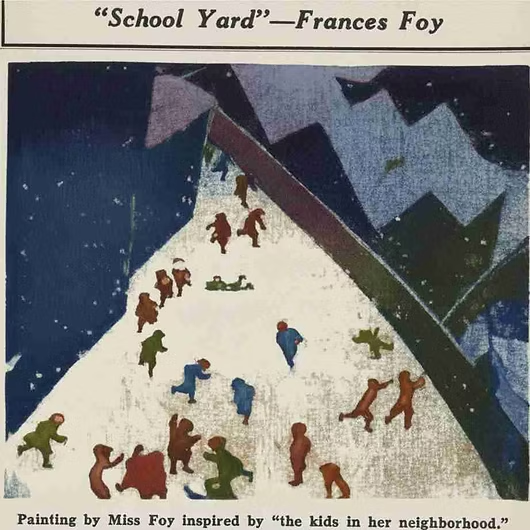
She started painting children, not from any over-developed "mother instinct" but "because there were so many kids in her neighborhood." She used in recent years her own youngster as model until of late (he is now half-past four) he wouldn't stay still long enough to pose.
She is resourceful and observant in life as in art. Once, in New Mexico, she and her horse were caught alone in a sudden sandstorm - a real stiff one that came up suddenly with a roar. The horse stuck his nose in the ground. So did Frances Foy, and she survived along with him.
|
 How Eddie Foy Got His Name