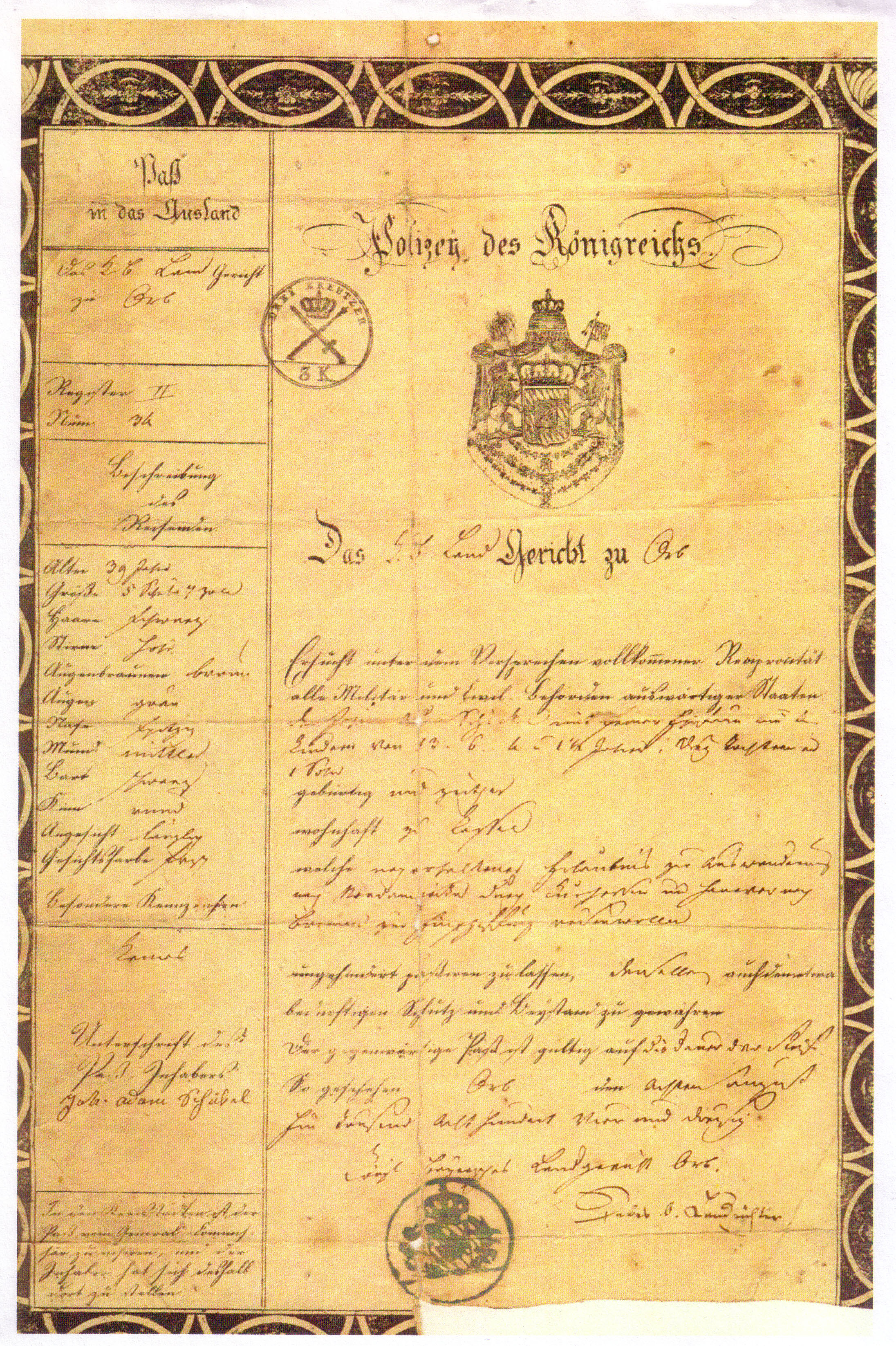
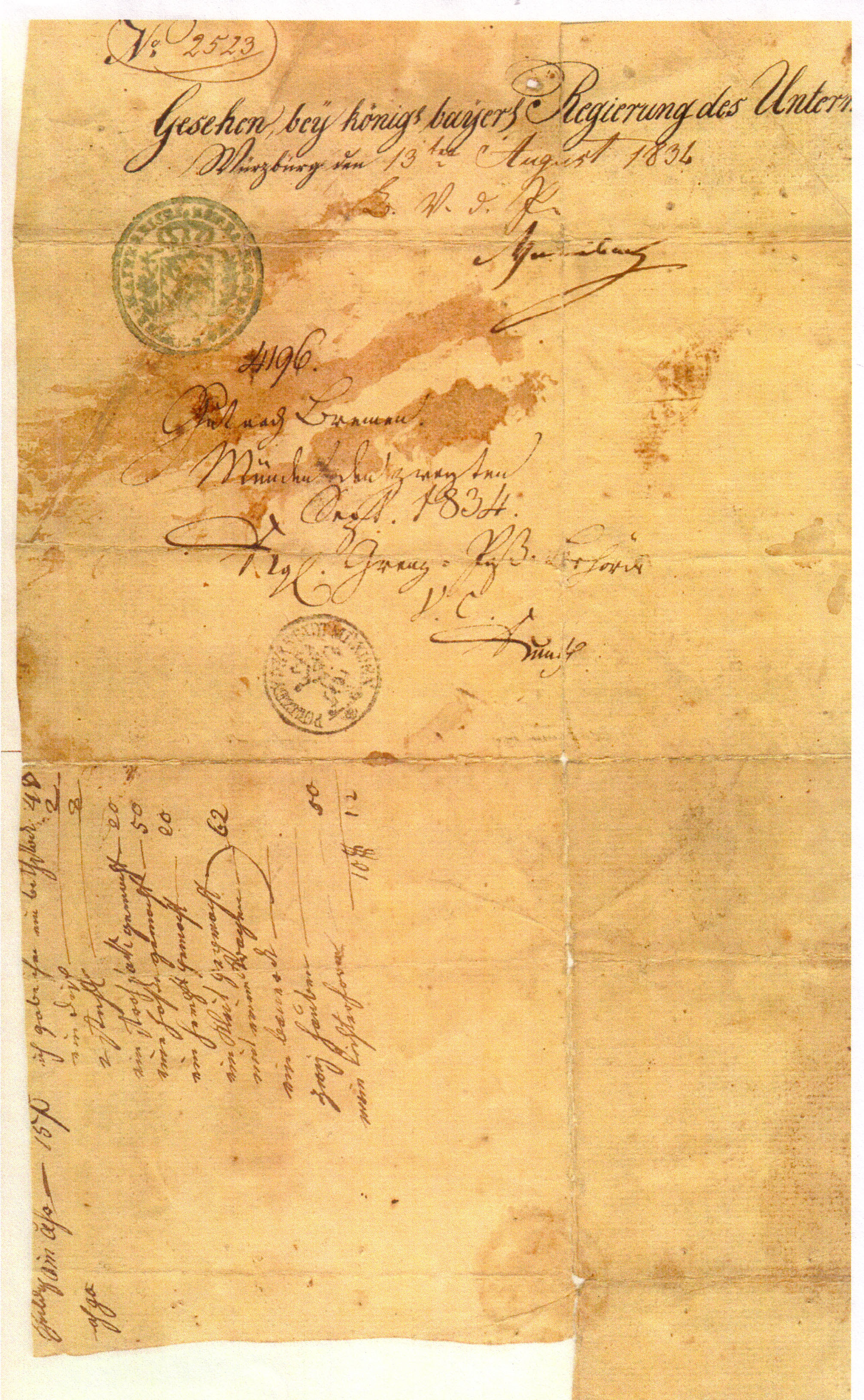
Passport of John Adam SchickellPassport of John Adam Schickell
Richard Drueke and Edward Biggins contributed to this page.
Immigration Family History Kassel to Tiffin Home Page
|
My great great great grandparents, John Adam and Maria Eva Schumm Schickell, came to America in 1834. They went by horse and wagon from their hometown in Kassel, Bavaria, to the seaport of Bremen, Prussia. They went by sailing ship from Bremen to Baltimore, Maryland. They went by horse and wagon from Baltimore to Tiffin, Ohio. Nineteen years later, in 1853, they moved from Tiffin to Grand Rapids, Michigan. The were six Schickells who came to America: John Adam, 39, a musician, and Maria Eva, 34, and their four children Veronica, 13, Mary Augusta 6, Mary Amalia, 4, and Peter, 1. They obtained a passport dated August 8, 1834, that gave them permission to emigrate from Bavaria to North America. The passport was issued by the Kingdom of Bavaria in 1834. The original is written on front and back. It was issued by the Police of the Kingdom at the Royal Bavarian State Court at Orb, which is five miles northeast of Kassel. The pass describes John Adam as 5 foot 7, black hair, black beard, high forehead, pointed nose, rounded chin, long face. On the back was a visa issued August 13, 1834, by the Royal Bavarian Government of the County of the Lower Main at Wurzburg, which is 55 miles southeast of Kassel. Richard Drueke obtained a translation of John Adam Schickell's passport. Following is the passport and the translation obtained by Richard.
In 2026, Edward Biggins used AI to see what they would say about the passport translation obtained by Eichard Drueke. Following is what AI came up with. Here is a thorough re-translation and re-interpretation of the 1834 passport for Johann Adam Schickel, filling in the gaps from the original translation by analyzing the visible German Kurrentschrift (cursive handwriting) in the provided documents. Key Corrections and Filled BlanksBased on the original German script visible in the passport images, here are the direct corrections to the previous translation’s missing or uncertain sections:
Fully Updated Translation of the Passport FrontLeft Column (Physical Description):
Center/Right Column (Main Body):
Police of the Kingdom [Seal of the Kingdom] The Royal Bavarian State Court at Orb Sought in accordance with the promise of complete reciprocity of all military and civilian jurisdictions of foreign states, Johann Adam Schickel with his wife, and then four children ages 13, 6, 4, and 1 year; three daughters and one son. Born and residing in Cassel. Who, by virtue of royal permission to emigrate to North America, is proceeding via Kurhessen and Hanover to Bremen, is to be allowed to pass freely and unhindered and is to be accorded all necessary protection and assistance. The present pass is valid for the duration of the journey. Processed at Orb on the eighth of August one thousand eight hundred thirty-four. Royal Bavarian State Court at Orb /s/ D. Bavarian State Judge Translation Notes on the Visa & "Owes" Ledger (Back of Passport)The Visa (August 13, 1834): The stamps on the back confirm the passport was "Seen at the Royal Bavarian Government of the County of the Lower Main at Wuerzburg". This was a necessary bureaucratic step: local authorities in Orb issued the pass, but the regional government in Würzburg had to counter-sign or "visa" it for international travel. The "Owes" Ledger: The bottom section translates a ledger ("made one Pants 50," "made one Dress 62," etc.). Without a high-resolution image of the actual German scribbles for this specific section, it is difficult to confidently correct the original translator's "[B..]" or "[D..]". However, the line "my Christmas Tree 50" is highly suspicious for a document signed in August 1834. In old German script, words like Weißzeug (white goods/linens) or Weste (vest/waistcoat) can easily be misread by translators. It is very likely a tailor's or outfitter's bill for the journey, given the references to jackets, pants, and shirts. Additional Historical & Genealogical Insights for the WebsiteThe Emigration Route: The newly translated text ("über Kurhessen und Hannover") perfectly outlines the Schickell family's overland journey. Traveling from Kassel (Bavaria) to the port of Bremen required crossing international borders, specifically traveling north through the sovereign Electorate of Hesse (Kurhessen) and the Kingdom of Hanover (Hannover). This explains why "complete reciprocity... of foreign states" was invoked—it functioned as a true international passport before a unified Germany existed. Spelling of Kassel/Cassel: The passport spells the town with a "C" (Cassel), which was the standard orthography in the 19th century before the spelling reforms modernized it to "Kassel." "Allerhöchste Erlaubniß" (Highest/Royal Permission): Emigration in 1834 Bavaria was not a guaranteed right; it required the state's permission. The family had to prove they had no outstanding debts or military obligations before receiving this allerhöchste Erlaubniß (royal permission) to leave the Kingdom of Bavaria forever. What was it like to get a passport?It was absolutely not a rubber stamp. In fact, obtaining official permission to emigrate from a German state like Bavaria in the 1830s was a rigorous, stressful, and highly bureaucratic process. It is estimated that only about half of the people who left Germany during the 19th century did so with official permission; the rest fled illegally in the dead of night specifically because they knew their applications would be denied. The formal release from state citizenship was known as Manumission (or Entlassung), and it generated a tremendous amount of anxiety for prospective emigrants. To receive that heavily stamped passport, a Bavarian citizen had to prove several things to the local authorities: No Outstanding Debts: The emigrant had to prove they owed no money to the state, local tradesmen, or private citizens. This often required the local court to publish a notice of the family's intent to emigrate in the local newspaper, giving creditors several weeks to come forward and make claims against them before the passport could be issued. Military Obligations Fulfilled: This was one of the most common reasons for denial. The state would not let young men leave if they had not fulfilled their compulsory military service, nor would they allow families to leave if they had teenage sons who were nearing conscription age. Proof of Sufficient Funds: Emigrants had to prove they had enough money to cover the overland journey to the port, the ship fare, and initial settlement in America. Bavarian authorities were terrified of poor citizens getting stranded at the ports in Bremen or Le Havre, running out of money, and being deported back to their hometowns as wards of the state. Emigration Taxes: Until treaties began abolishing them later in the century, emigrants often had to pay an exit tax (sometimes called Abzugsgeld or Nachsteuer) on the total value of the property and wealth they were taking out of the kingdom. The Angst and Strife The process was fraught with risk. Families often had to sell their homes, land, and businesses to prove they had the liquid funds for the journey, but they had to do so before final permission was guaranteed. If a sudden creditor appeared, or a local magistrate decided a son was too close to military age, the family could be stripped of their livelihood and trapped in Bavaria. Because Johann Adam Schickell was 39 years old (past primary military age) and his only son was 1 year old, the military hurdle was likely lower for him. However, the fact that he possessed this official, multi-stamped document proves he was a man of financial means and good civic standing who successfully navigated a very strict bureaucratic gauntlet. | ||||||||||||||||||||||||||||||||||||||||||||||||||||||||||||||