Francis BigginsFrancis Biggins
Francis Born in 1838
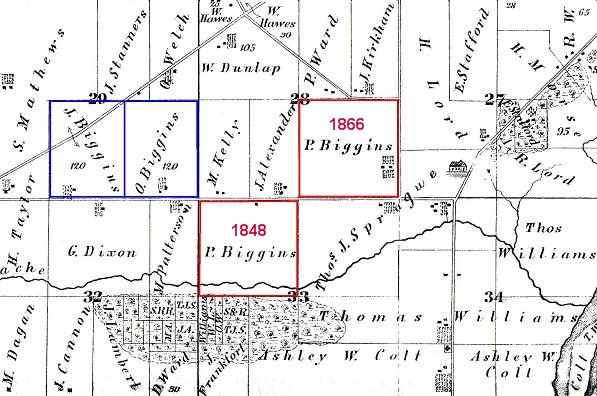
Francis was the third child of Patrick and Bridget Biggins, who had immigrated, most likely, from County Cavan, Ireland, to Ontario, Canada, to Lockport in the 1830s. Their earlier children were a girl born in 1826-30 and Ann born in 1833 in Ontario Canada. In 1840, Francis' brother Philip was born. In 1840, Francis' sister Catherine was born. In 1843, Francis' sister Rosanna was born. In 1846, Francis' brother James was born. Lockport is 35 miles southwest of downtown Chicago. The town got its name and its start in 1836, when the Commissioners of the Illinois & Michigan Canal selected it as headquarters for the canal and site of Lock No. 1. Romeoville, 1848-1885. On September 11, 1848, Francis' father Patrick Biggins purchased 160 acres of land from the Illinois & Michigan Canal Commission for $640. The land was on the south side of what is now the equivalent of 755 W. Normantown Road in Romeoville, Illinois. The western 80 acres is now a subdivision called Lakewood Estates. The eastern 80 acres is now the Beverly Skoff Elementary School and the John J. Lukancic Middle School.
Francis' father Patrick farmed the land he bought. So, Francis, from age 10, grew up on a farm.
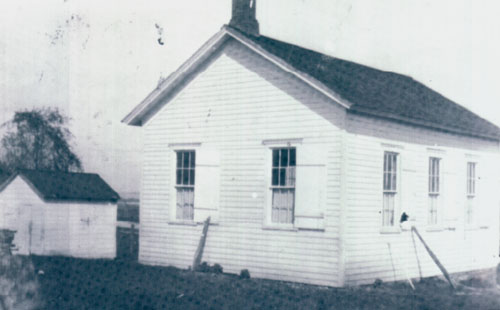
Francis attended Sprague School in a one-room school house on the Thos. J. Sprague farm that abutted the Patrick Biggins farm on the east. The school was on the northwest corner of Normantown Road and Joliet Road. School attendance did not become compulsory in Illinois until 1883. The picture and information about the school were provided by Dorothy Hassert of the Fountaindale Historical Society, which is part of the Romeoville Public Library. In 1855, Francis' sister Ann married Hugh Gaffey. Francis' mother Bridget died sometime in the 1850s, when he was between age 12 and 22. On June 23, 1866, Francis' father Patrick purchased an additional 160 acres on the north side of Normantown Road, just east of the original 160 acres, for $6,500. In 1874, Patrick's children bought his land for $13,700.
Francis' sister Rosanna last appears in Patrick's 1874 Will. In April 1875, Francis' brother James married Elizabeth Healy. James and Elizabeth had two children: Rosanna in 1876 and Virginia in 1878. Following their wedding, James and Elizabeth lived on the family farm in Romeoville. In August 1875, Francis' brother Philip married Sarah Ella McNally. Philip and Sarah lived on the family farm in Romeoville. Although the farm had been split up among the children a year before the marriage, they probably continued to operate it as one farm. Philip and Sarah had two children: Leslie in 1877 and Arthur in 1880. The 1880 census shows Francis living in dwelling 138 with the Benjamin and Sophia Barrett family in DuPage Township. The family was from England. Benjamin was a farmer. Also living there was their daughter Betsy, 35, and sons John, 30, William, 27, George, 22, and Arthur, 18. Francis was working as a farm laborer. Also living there were Robert Chapman, 5, an adopted son, and Leroy Williams, 32, a carpenter. The rest of Francis' family is shown in the 1880 census as follows.
In 1881, the Will County Commercial Advertiser included an item in the DuPage Township section about Francis: "Frank Biggins is the happiest man in town. It s a boy." Frances was 43. We do not, however, know who the mother was or the name of the child. In 1883, Francis' father Patrick died at age 75 of consumption. The Will County Commercial Advertiser reported the day after that consumption, that relentless destroyer of man, was the disease that sought and finally carried him to his long home the morning of April 10th. Funeral rites at St. Dennis Church included Solemn High Mass. Probate records for Patrick were obtained from the Illinois Regional Archives Depository at Northern Illinois University. Patrick s son James A. Biggins was executor of his estate. Patrick s will, dated 1874, left $75 to his daughter Ann Gaffey and $5 to his son Francis. Then, the remainder was to pay off two loans: $1,000 secured by the land Patrick sold his son Philip Biggins and $500 secured by the land he sold his son James A. Biggins. Then, the remainder was to be paid equally to four of his children Philip, James A., Catherine, and Rosanna. In May 1883, Ann Gaffey's daughter Frances Jane Jennie married Edward Roades. The Will County Commercial Advertiser reported the marriage took place at the home of her aunt Catherine Kate Biggins in DuPage Township (Patrick s home before his death a year earlier). They were married by Rev. Dr. James J. McGovern, pastor of St. Dennis Church in Lockport. The newspaper reported that as both parties were young folks of worthy popularity, a large number of friends and relatives were present to congratulate and witness the happy event. After the ceremony a bountiful repast was spread, to which all paid due tribute. Joliet, 1885-1891. In 1885, Francis moved to Joliet with his sister Catherine. They lived at 406 Western Avenue. That same year, Philip and Sarah moved 10 miles north to the east side of Naperville with their sons Leslie, 8, and Arthur, 5. They still owned the 80 acres of farmland in DuPage Township. Naperville is in DuPage County. The Biggins farm was in DuPage Township in Will County. James and his wife Elizabeth remained on the family farm. In 1889, the Will County Circuit Court ordered the Sheriff to sell Philip s 80 acres and Francis 40 acres to Fithian & Cowing to settle debts. Each had 15 months to redeem the property. Philip s debt was to the estate of Barrett B. Clark. Francis debt was to the estate of George J. Munroe. On March 16, 1890, Francis' brother James died at age 44. He was buried in St. Dennis Cemetery at 17th and Jefferson Streets in South Lockport in a plot that is separate from their father's. His wife Elizabeth continued to operate the farm. The 1900 census shows her as a farmer. The Joliet city directory shows her as a resident starting in 1904. | ||
Francis Biggins Dies in 1891 at age 53The Will County Coroner s Record of September 24, 1891, obtained from the files of the Will County Historical Society, reported that Patrick and Bridget's son Francis was run over by a Chicago & Alton railroad train in Lockport "while trying to board it under influence of liquor." Francis was 53. The Joliet Public Library found three local newspaper stories about the death of Francis. Daily News, Joliet, Ill., September 24, 1891, page 3 The News, Joliet, Ill., September 24, 1891, page 2 Joliet Republic and Sun (weekly), September 25, 1891, page 4 | ||
From Plain Site: https://www.plainsite.org/opinions/2bhhlc30w/biggins-v-biggins/ James A. Biggins v. Francis BigginsIllinois Supreme Court24 N.E. 516133 Ill. 211Filed: May 14, 1890 | Craig | Author: Mr. Justice Craig SummaryAppeal from the Circuit Court of Will county; the Hon. George W. Stipp, Judge, presiding.This was a bill in equity, brought by Francis Biggins, to establish an alleged trust in certain real estate in Will county. It is alleged in the bill, that on or about the 11th day of January, 1873, Patrick Biggins, the father of complainant, being desirous of giving his children the real estate which he then owned, conveyed to the complainant the east half of the northwest quarter of section 33, town 37 north, range 10 east, in Will county, except a small part thereof; that at the same time Patrick Biggins conveyed to each of his other children (James, Philip and Catherine Biggins, and Anna Gaffey,) a like quantity of land. It is also alleged, that on or about that time the complainant was addicted to the use of intoxicating liquors, and was in the habit of wasting his money and property, and wandering about with unsettled habits and without any fixed home, he being then, and still remaining, unmarried; that his sister, Catherine Biggins,- had considerable influence over him, and had the reputation of being a woman of some ability in the management of her financial affairs and property ; that complainant, upon consultation with her and upon her advice, deemed it safest to convey the said eighty-acre tract so given him by his father, unto said Catherine Biggins, to hold in trust for complainant, in order that he might not squander and waste the same; that pursuant to that understanding, on the 18th day of December, 1876, complainant, by warranty deed, for the expressed consideration of $4000, conveyed said land to Catherine Biggins, and she immediately went into the possession of the same, and enjoyed the use, rents and profits thereof from thence until the date of her death, but that no money whatever was paid by Catherine Biggins to complainant in payment for said land, and none demanded, it being understood that she held it simply in trust for him; that said Catherine Biggins always acknowledged the trust reposed in her by said conveyance, and frequently mentioned different modes by which she would reinvest complainant with the title to said land, but he, being a single man and still continuing to lead an unsettled life, never demanded from her a reconveyance of said property, and she expressed her intention of executing a will which would vest the title in him at her death, unless she should sooner convey to him. It is also alleged, that on the 8th day of May, 1886, Catherine Big-gins died intestate, and on the 10th day of the same month letters of administration were issued to her brother, James Biggins, upon her said estate; that she died unmarried, leaving complainant, James Biggins, Philip Biggins and Anna G-affey, her brothers and sister, as her sole heirs-at-law. The \"bill prays that the land be decreed to have been held in trust by Catherine Biggins for complainant, and that the same may be decreed equitably to belong to him, and a conveyance thereof ordered by the court. The answer of the defendants admits the execution and delivery of a warranty deed from complainant to Catherine Biggins for the land in question, on December 18, 1876, for an expressed consideration of $4000; that said Catherine thereupon went into actual and exclusive possession of said land as owner, and received the rents and profits therefrom, such as they were, with the knowledge of and without objection from appellee, and without accounting or being called upon to account therefor, to the date of her death, a period of upwards of nine years; avers that the trust deed to Woodruff, executed by said Catherine while owner and in possession of said premises, was and is a valid lien, etc.; admits that appellee never demanded from said Catherine a reconveyance of said land; avers that it may possibly be true that she may have indicated or intimated her intention to give, by way of testamentary disposition, this portion of her estate to appellee, but neither admits nor denies the same; avers that said Catherine was guilty of no fraud in acquiring said title to said land; that the supposed trust claimed by appellee was never evidenced by any declaration in writing; denies all the other allegations in said bill of complaint, and especially denies the existence of any valid trust; avers that if said title was vested in said Catherine in trust, as supposed in said bill, the same was an express trust, without any declaration thereof in writing, and was and is void by force of the statute in such case made and provided; sets up the Statute of Frauds and Perjuries, and charges laches on the part of appellee. Syllabus1. Trusts - trust resting in parol - Statute of Frauds. An. express trust between the grantor and grantee of land, that the latter is to hold the land in trust for the former, or is to reconvey to him on a certain contingency, is invalid, under the Statute of Frauds, unless evidenced by some writing - signed by the 2. If A voluntarily conveys land to B,the latter having employed no means to procure the conveyance, but accepts it and verbally promises to hold the property in trust for A, the case will fall within the statute, and a court of equity will not enforce the parol promise. But, it has been held, if A was intending to convey to O, and B interfered, and advised A not to convey to 0, but to him, promising if A would do so, he (B) would hold the land in trust for 0, a court of equity will lend its aid to enforce the trust. 3. Same resulting trust whether it arises. The owner of a tract of land conveyed the same to another by an absolute and unconditional deed, upon the verbal promise of the latter to hold the land in trust for his use. Ho consideration was paid, and the grantee did or said nothing to induce the conveyance: Held that there was no statement of a resulting trust in the case, and that there was no trust created by implication or operation of law. delivered the opinion of the Court:The land in controversy was conveyed by Francis Biggins to Catherine Biggins on December 18, 1876, by a warranty deed absolute in terms, without condition or reservation. The consideration named in the deed was $4000, but it appears from the evidence that no money consideration was" paid for the conveyance. After the execution and delivery of the deed Catherine Biggins went into the possession of the land, received the rents and profits, and used it in every respect as iter own until her death, on the 8th day of May, 1886. On the 14th day of April, 1884, Catherine Biggins borrowed $600 of one Woodruff, and to secure the payment of the money and interest, executed a trust deed on the premises. The money was never paid, and at her death the land remained ineum•bered with the deed of trust. What contract was made between Catherine and appellee when the deed was executed, the evidence fails to disclose. WOT Myers drafted the deed, but in his evidence he says he can not remember that any statement or statements were made, or conversation had between them, when the deed was made or executed. No witness was called to prove a contract or agreement entered into between the parties, under which the land was conveyed. No writing -was introduced except the deed, and the only way in which the complainant undertakes to establish a trust, is by proving the declarations of Catherine Biggins, made several years after the deed was executed. The court, on the evidence, decreed in favor of the complainant, and for the purpose of determining whether the decree can be sustained, it will be necessary to refer briefly to the evidence contained in the record. The evidence introduced was of a two-fold character: First, the declarations of Catherine Biggins, to show how she held the title to the land; and second, evidence bearing upon the habits and capacity of the appellee, Francis Biggins. The ¡first witness who testified to declarations was Jane Stafford. She said: “I heard Catherine speak of the eighty in controversy. She said it was deeded to her for safe keeping, so that Frank Biggins would not spend it. She had not paid anything for it.” This talk was about three years before Catheriné died. The next witness was John B. Murray. He had two conversations with her—the first, four years ago, and the last one on July last. In the first conversation she wanted the witness to act as her executor. She said she was in poor-health, and did not know how soon she should die; that if she should, and beat Frank out of his farm, she did not think she could rest easy in her grave. She said Frank gave her a deed, of the land some time before, but she had never given him any money for it. She said she wanted to will the farm to Frank, for there would be trouble about it in the family if she should die and leave it without a will. Ellen Murphy testified she heard Catherine talk about the farm at different times, - first, three years ago. She said Frank gave her eighty acres of land - that she paid no money for it; that she intended to give it back to Frank. "She came seven or eight different times to my house, and wanted my husband to go with her to settle up-matters, and nearly every time she spoke of deeding Frank: over his farm." August Isted testified: "I heard her (Catherine) speak of the property relations between her and Frank. She said she was not long for this world; that Frank Bigginshad some trouble, and signed the farm over to her for safekeeping ; that she-had mortgaged it for $500, and had to straighten it up, and give him his land back." James J. McGovern, a Catholic clergyman, testified that he had a conversation with Catherine in 1884. She said she had eighty acres-of land from Frank, which he had deeded to her in trust, to care-for it, because Frank’s roving ways and disposition were such, that he could not manage it, and would lose it. The witness further stated that he had two or three other conversations with Catherine after she moved to Joliet, the last being at his residence in Lockport, when she spoke of deeding the land to Frank, and he advised her to do so. She requested witness to come to Joliet some day, and go with her to a lawyer, and arrange matters satisfactorily. The foregoing is, in substance, the evidence relied upon to-show that Catherine Biggins held the land in trust. The evidence introduced to show that Frank Biggins was of a roving' disposition, or in the habit of drinking, or incapable of attending to business, is very weak and unsatisfactory. Ireson, who knew him wrell, and testified for complainant, said: “I saw Frank Biggins in 1876. Saw him often then for two or three years. He would roam around sometimes, and used to drink, a little, but not to any extent, that I know of.” This is the-strongest evidence found in the record, on this branch-of the case. The record contains no evidence that Frank Biggins was an habitual drunkard, or that he was in the habit of becoming intoxicated; nor do we find any evidence that he-was a tramp, a wanderer, or a person in the habit of roaming about from place to place; nor does this record contain any evidence that he was incompetent to hold property and transact ordinary business. Indeed, it appears that he obtained the title to the land in controversy in January, 1873, and held it until December, 1876,—nearly four years,—and during this time the land was not incumbered, nor was any portion of it sold or lost. This fact, of itself, would seem to indicate that the capacity of Frank Biggins to hold and manage property was not deficient, but, on the other hand, was quite as good, if not better,, than his sister Catherine’s, who, as the evidence shows, was not able to hold the land without mortgaging it for borrowed money. So far, therefore, as the decree rests upon the supposed incapacity of Frank Biggins to take care of his property, in consequence of his wandering habits or his habits of intoxication, it finds no support in the evidence. The decree, if it can be sustained, must be upon the declarations of Catherine that the land was conveyed to her, as one witness said, for safe keeping; or, as stated by another, that she had eighty acres of land from Frank which lie had deeded to her in trust; or, as testified by another, that Frank had some trouble, and signed the farm over to her for safe keeping. Section 9, chapter 59, of our statute, provides: “All declarations or creations of trusts or confidences of any lands shall be manifested and proved by some writing signed by the party who is by law enabled to declare such trust, or by his last will in writing, or else they shall be utterly void and of no effect: Provided, that resulting trusts, or trusts created by construction, implication or operation of law, need not be in writing, and the same may be proved by parol.” There is no element of a resulting trust in this transaction, and it is not even claimed that it is a resulting trust. Was it a trust created by construction, implication or operation of law? We find nothing in the transaction which will bring it within this part of the proviso. So far as appears from the evidence the land was conveyed to Catherine Biggins on her mere verbal promise to hold it in trust for Frank Biggins, and it needs no argument to prove that a promise or agreement of this character, under which a trust is attempted to be established, falls within the statute. Stevenson v. Crapnell, 114 Ill. 19, is a •case in point. It is there held, that an express trust between .the grantor and grantee of land, that the grantee is to hold the land in trust for the grantor, or is to reconvey to him on a certain contingency, is invalid, under the Statute of Frauds, unless evidenced by some writing signed by the grantor. Had Catherine Biggins obtained the execution and delivery of. the deed by undue means or fraud, on a parol promise to hold the land in trust for the grantor, a court of equity would not hesitate to lend its aid to enforce the trust, as held in Gruhn v. Richardson, 128 Ill. 180. Lantry v. Lantry, 51 Ill. 462, is a case where the rule applicable to a transaction of this character is clearly laid down. It is there said: "If A voluntarily conveys land to B,"the latter having taken no measures to procure the conveyance, but accepting it, and verbally promising to hold the property in trust for C, the case falls within the statute, and chancery will not enforce the parol promise. But if A was intending to convey the land, directly to C, and B interfered, and advised A not to convey directly to C, but to convey to him, promising if A would do so he (B) would hold the land in trust for chancery will lend its aid to enforce the trust." Here, so far as appears from the evidence, the land was conveyed from Frank Biggins to Catherine of his own voluntary free will and accord. She resorted to no undue means to procure the conveyance. She neither solicited nor induced the conveyance. There is therefore nothing in the evidence from which fraud could be imputed to her. It is argued that there was a confidential relation existing between the parties, and on that account a court of equity ought to interfere and establish the trust. There was no relation of guardian or conservator in this case. The grantee was a sister of the grantor, but she had no control over him or his property. He lived with her, but, so far as appears, he supported himself, and had charge of his own business. She was in no sense his guardian or conservator, nor did she control his business. There is nothing in the evidence, when it is fairly considered, which can take this transaction out of the operation of the Statute of Frauds. Catherine Biggins paid nothing for the land, and no doubt promised, verbally, to hold it for Frank, and no doubt intended to deed it or will it to him; but she failed to do so, and a court of equity has no power to grant relief, unless the statute is entirely disregarded. That can not be done. We think the evidence fails to support the decree. It will be reversed, and the cause remanded for further proceedings in conformity to this opinion. Decree reversed. |
 Lockport, 1838-1848. Francis Biggins was born in 1838, in Lockport, DuPage Township, Will County, Illinois. In 1838, there were 26 states in the Union, the last being Michigan.